 ToolNest
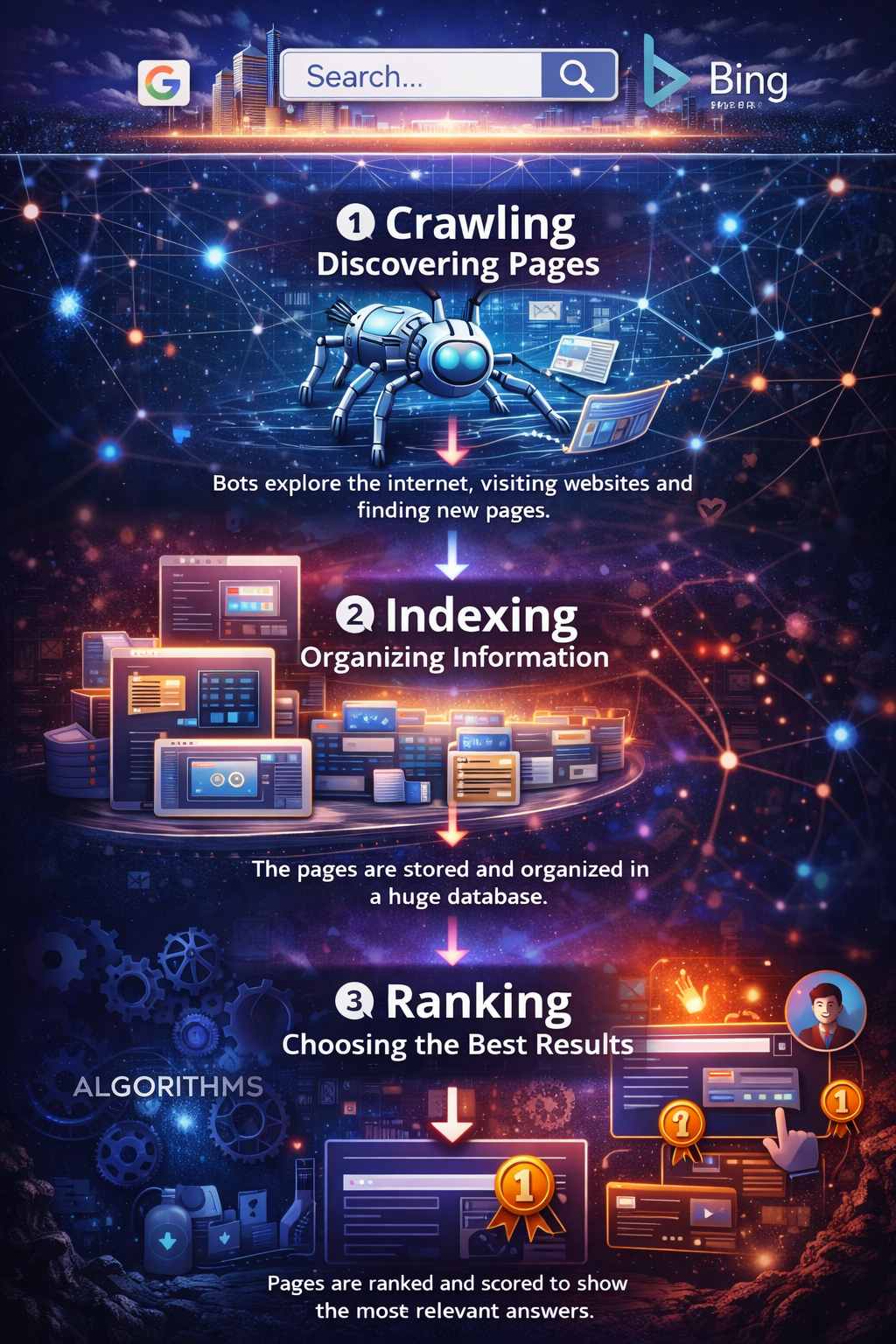
How Search Engines Actually Work Behind the Scenes
Every day, billions of people type questions into Google, Bing, or other search engines.
“Best phone under 20,000”
“How to lose weight fast”
“Laravel interview questions”
In less than a second, you get the perfect answers.
It feels like the internet is reading your mind.
But behind this simple search box is one of the most powerful systems ever built—running silently, 24/7, across the entire web.
Let’s explore what really happens when you press Enter.
🌍 The Internet Is Too Big to Read Manually
There are billions of web pages online.
No human can:
-
Visit them all
-
Read them
-
Organize them
-
Update them
So search engines use machines to do this work automatically.
These machines perform three main jobs:
-
Crawl – Discover pages
-
Index – Store and organize them
-
Rank – Decide which one is best for your search
Every search result you see is the output of these three steps.
🧭 Step 1: Crawling – Exploring the Web
Search engines send out automated programs called crawlers (or bots).
Their mission is simple:
-
Visit websites
-
Read pages
-
Follow links
-
Find new content
They move from one page to another just like a human clicking links.
When you publish a new blog:
-
A crawler eventually visits your site
-
Reads your page
-
Understands your topic
-
Sends this information back
If your website is:
-
Fast
-
Mobile-friendly
-
Well-linked
-
Has a sitemap
…it gets discovered faster.
Think of crawlers as digital explorers mapping the internet.
🗂️ Step 2: Indexing – Building a Giant Brain
After a page is crawled, it is processed and stored in a massive database called the index.
This index contains:
-
Page text
-
Headings
-
Keywords
-
Images
-
Structure
-
Meaning
It’s like a global digital library.
When your page is indexed, it becomes eligible to appear in search results.
If it is not indexed, it simply does not exist for search engines.
That’s why:
-
Proper titles
-
Clear headings
-
Clean HTML
-
No blocking rules
…are extremely important.
🏆 Step 3: Ranking – Choosing the Best Answer
Now comes the smartest part.
When someone searches:
“Best free SEO tools”
The search engine:
-
Looks into its index
-
Finds thousands of related pages
-
Analyzes each one
-
Scores them using hundreds of signals
-
Shows the best results first
Some key ranking signals include:
-
Content quality
-
Topic relevance
-
Page speed
-
Mobile experience
-
Backlinks from other sites
-
User behavior (clicks, time spent)
-
Freshness of content
The mission is simple:
Give the most helpful answer in the shortest time.
⚡ What Happens in a Fraction of a Second?
All this happens in milliseconds:
-
Billions of pages are scanned
-
AI models understand your intent
-
Results are sorted
-
Best matches appear
You see answers in under one second.
This is not magic.
It’s engineering at its finest.
📈 Why SEO Exists
SEO is not about tricking search engines.
It exists to:
-
Help machines understand your content
-
Help users find better answers
-
Improve clarity and structure
-
Enhance user experience
Good SEO is simply:
Helpful content + Clear structure + Fast performance
That’s it.