ToolNest – Technology Blog https://toolnests.in/blog en-IN Thu, 29 Jan 2026 11:50:47 +0000 <![CDATA[How Search Engines Actually Work Behind the Scenes (Beginner-Friendly Guide 2026)]]> https://toolnests.in/blog/how-search-engines-actually-work-behind-the-scenes-beginner-friendly-guide-2026 https://toolnests.in/blog/how-search-engines-actually-work-behind-the-scenes-beginner-friendly-guide-2026 Sun, 18 Jan 2026 17:09:48 +0000 How Search Engines Actually Work Behind the Scenes

Every day, billions of people type questions into Google, Bing, or other search engines.

“Best phone under 20,000”
“How to lose weight fast”
“Laravel interview questions”

In less than a second, you get the perfect answers.

It feels like the internet is reading your mind.

But behind this simple search box is one of the most powerful systems ever built—running silently, 24/7, across the entire web.

Let’s explore what really happens when you press Enter.


🌍 The Internet Is Too Big to Read Manually

There are billions of web pages online.

No human can:

  • Visit them all

  • Read them

  • Organize them

  • Update them

So search engines use machines to do this work automatically.

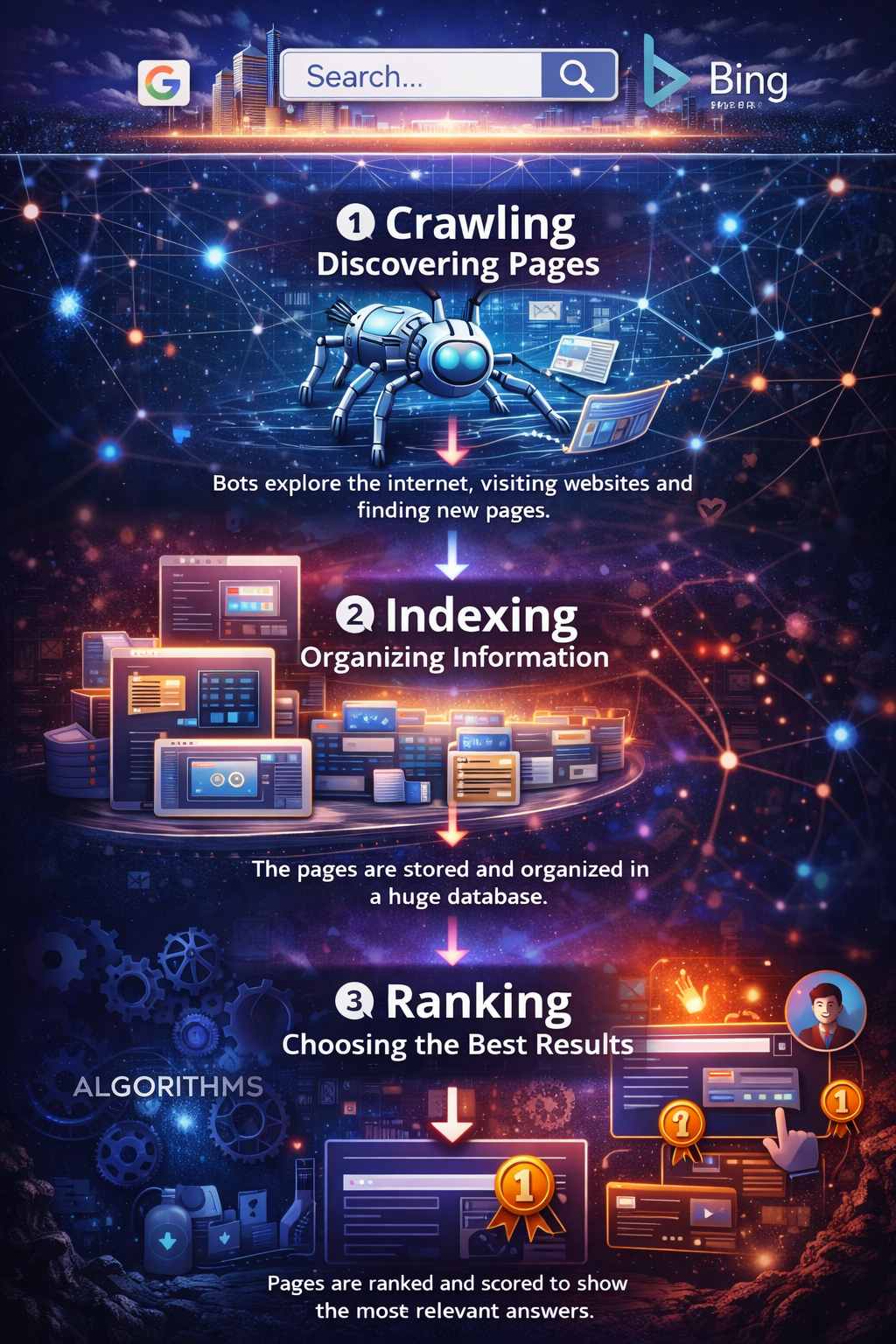
These machines perform three main jobs:

  1. Crawl – Discover pages

  2. Index – Store and organize them

  3. Rank – Decide which one is best for your search

Every search result you see is the output of these three steps.


🧭 Step 1: Crawling – Exploring the Web

Search engines send out automated programs called crawlers (or bots).

Their mission is simple:

  • Visit websites

  • Read pages

  • Follow links

  • Find new content

They move from one page to another just like a human clicking links.

When you publish a new blog:

  • A crawler eventually visits your site

  • Reads your page

  • Understands your topic

  • Sends this information back

If your website is:

  • Fast

  • Mobile-friendly

  • Well-linked

  • Has a sitemap

…it gets discovered faster.

Think of crawlers as digital explorers mapping the internet.


🗂️ Step 2: Indexing – Building a Giant Brain

After a page is crawled, it is processed and stored in a massive database called the index.

This index contains:

  • Page text

  • Headings

  • Keywords

  • Images

  • Structure

  • Meaning

It’s like a global digital library.

When your page is indexed, it becomes eligible to appear in search results.

If it is not indexed, it simply does not exist for search engines.

That’s why:

  • Proper titles

  • Clear headings

  • Clean HTML

  • No blocking rules

…are extremely important.


🏆 Step 3: Ranking – Choosing the Best Answer

Now comes the smartest part.

When someone searches:

“Best free SEO tools”

The search engine:

  1. Looks into its index

  2. Finds thousands of related pages

  3. Analyzes each one

  4. Scores them using hundreds of signals

  5. Shows the best results first

Some key ranking signals include:

  • Content quality

  • Topic relevance

  • Page speed

  • Mobile experience

  • Backlinks from other sites

  • User behavior (clicks, time spent)

  • Freshness of content

The mission is simple:

Give the most helpful answer in the shortest time.


⚡ What Happens in a Fraction of a Second?

All this happens in milliseconds:

  • Billions of pages are scanned

  • AI models understand your intent

  • Results are sorted

  • Best matches appear

You see answers in under one second.

This is not magic.
It’s engineering at its finest.


📈 Why SEO Exists

SEO is not about tricking search engines.

It exists to:

  • Help machines understand your content

  • Help users find better answers

  • Improve clarity and structure

  • Enhance user experience

Good SEO is simply:

Helpful content + Clear structure + Fast performance

That’s it.

]]>
<![CDATA[What Is the Dark Web? Myths vs Reality (2026 Guide for Beginners)]]> https://toolnests.in/blog/what-is-the-dark-web-myths-vs-reality-2026-guide-for-beginners https://toolnests.in/blog/what-is-the-dark-web-myths-vs-reality-2026-guide-for-beginners Sun, 18 Jan 2026 15:58:48 +0000 What Is the Dark Web?

Myths vs Reality

When people hear “Dark Web”, they imagine hackers in hoodies, illegal markets, and hidden corners of the internet. Movies and news have painted it as a digital underworld.

But how much of that is true?

In reality, the Dark Web is neither purely evil nor something magical. It’s simply a private, encrypted part of the internet—and like any tool, it can be used for both good and bad.

Let’s separate myths from reality.


🌐 Understanding the Internet Layers

The internet has three main layers:

  1. Surface Web – Google, YouTube, news sites, blogs.

  2. Deep Web – Private content like emails, bank dashboards, cloud storage.

  3. Dark Web – Encrypted networks accessible only with special software (like Tor).

The Deep Web is not the Dark Web.
Your Gmail and bank account are part of the Deep Web, not the Dark Web.


🧠 Myth #1: “The Dark Web Is Illegal”

Reality: The Dark Web itself is not illegal.

It’s just a technology that allows:

  • Anonymous communication

  • Censorship-resistant publishing

  • Privacy-focused browsing

Journalists, activists, whistleblowers, and even governments use it to:

  • Share sensitive information

  • Bypass censorship

  • Protect identity in hostile regions

Illegal activities exist there—but that doesn’t make the entire network illegal.


🕵️ Myth #2: “Only Hackers Use the Dark Web”

Reality: Many normal people use it for legitimate reasons:

  • Journalists protecting sources

  • Citizens in censored countries

  • Researchers studying cybercrime

  • Privacy-focused users

It’s like saying “Only criminals use VPNs.”
The tool is neutral. The intent matters.


💀 Myth #3: “You’ll Get Hacked Just by Opening It”

Reality: Simply accessing the Dark Web doesn’t automatically infect your device.

The real dangers come from:

  • Downloading unknown files

  • Clicking shady links

  • Trusting random marketplaces

  • Disabling security settings

Just like the normal web, unsafe behavior creates risk.


⚙️ How the Dark Web Works (Simply)

The most common gateway is Tor (The Onion Router).

Tor:

  • Encrypts your traffic

  • Routes it through multiple nodes

  • Hides your IP and location

Websites on Tor end with .onion and are not indexed by Google.

This makes:

  • Tracking difficult

  • Surveillance harder

  • Privacy stronger


⚠️ Real Risks You Should Know

The Dark Web is not a playground. It has real dangers:

  • Scams & fake marketplaces

  • Malware-infected files

  • Phishing traps

  • Law enforcement honeypots

There is:

  • No customer support

  • No refund

  • No safety net

One mistake can cost data, money, or privacy.


🧭 The Truth

The Dark Web is:

  • ❌ Not a magical hacker universe

  • ❌ Not illegal by default

  • ❌ Not instantly dangerous

It is:

  • A privacy-first network

  • A tool for freedom of speech

  • A space with both light and dark sides

Like fire, it can warm a home—or burn it down.


Final Thought

The Dark Web isn’t evil.
It’s powerful.

And power always depends on who holds it.

Understanding it makes you:

  • More cyber-aware

  • Safer online

  • Better informed

Fear comes from mystery.
Knowledge replaces fear with control.

]]>